What the Orchestration Pattern Actually Does
The orchestration pattern introduces a supervising agent or control layer that manages how other agents operate within a system.
Instead of letting agents organize themselves, the supervisor assigns tasks, controls the order of work, enforces rules, manages shared information, handles failures, decides when to escalate issues, and knows when to involve humans.
Orchestration separates who makes decisions from who does the work. This is similar to how effective organizations operate: teams do not self-direct without leadership, oversight, or defined boundaries. Multi-agent AI systems should not either.
Why Orchestration Is Where Enterprise Agentic AI Breaks
Up until the point where multiple agents must collaborate, many agentic implementations succeed through careful prompting, well-defined tools, and clear boundaries.
But as soon as you use multiple agents, that sense of control disappears.
When multiple agents work together, someone needs to decide who acts next, resolve any conflicts, stop runaway behavior before costs get out of hand, and take responsibility if things go wrong.
Without orchestration:
- Agents talk past each other without shared context.
- Token costs and API calls multiply faster than value creation.
- Errors compound across agent interactions.
- It’s impossible to track who is responsible when things fail.
McKinsey’s November 2025 research on agentic AI emphasizes that as agents evolve from passive copilots to proactive actors and scale across the enterprise, the complexity they introduce will be organizational, not just technical. The real challenge lies in coordination, judgment, and trust. Orchestration provides the organizational structure that multi-agent systems require to operate safely under enterprise conditions.
Gartner’s December 2025 multi-agent systems analysis reports a 1,445% surge in multi-agent system inquiries from Q1 2024 to Q2 2025, reflecting explosive enterprise interest. However, that same research warns that multi-agent systems introduce new complexities: larger security attack surfaces, greater integration and monitoring requirements, cost management challenges, and reliability concerns due to compounded errors. Organizations must adopt governance, observability, and compliance frameworks from the start, using orchestrated workflows to validate agent actions and outputs at every step.
This is why orchestration is essential. It’s the control layer that keeps multi-agent complexity from turning into a liability.
What the Orchestrator Actually Does in Production Systems
Many people think orchestration is just about routing tasks or managing workflows, but it’s much more than that.
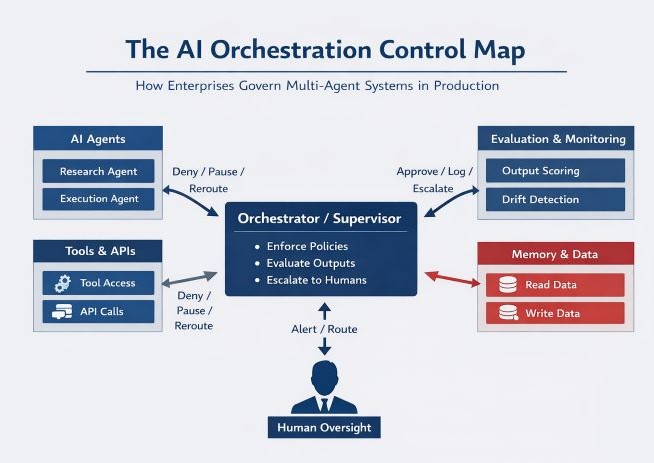
In enterprise systems, the orchestrator does much more than just coordinate tasks.
Why Multi-Agent Systems Fail Without Orchestration
Most failures in multi-agent systems stem from poor coordination, not from intelligence failures. The individual agents often perform well in isolation, but the system fails when those agents must work together.
Common failure symptoms show up quickly without proper orchestration. Agents may duplicate work because no central authority is tracking task completion. They can produce conflicting outputs with no mechanism to resolve disagreements or prioritize results. Some systems fall into long-running loops that never converge because no supervisor detects the pattern and intervenes. In other cases, agents take unauthorized actions that exceed their intended scope. And when something goes wrong, organizations often can’t explain how decisions were made because no central authority maintains execution context.
These problems can happen even if each agent works well on its own. Orchestration is there to manage how agents interact and how the whole system behaves, not to improve individual agent intelligence.
with task-specific AI agents by the end of 2026 suggests that the orchestration challenge will only intensify. As agents proliferate across enterprise applications, the need for coordinated control becomes increasingly critical.
Orchestration Versus Planning: Control Versus Intent
Planning defines what should happen. Orchestration makes sure that what actually happens matches the plan.
A plan without orchestration assumes everything will go perfectly under ideal conditions, but enterprise systems can’t count on that. Real-world conditions deviate from plans. Deviations may include: external systems fail, data quality issues surface mid-execution, agent outputs fail validation, costs exceed budgets, and execution time exceeds acceptable thresholds.
The orchestrator monitors what’s really happening and adjusts when things don’t go as planned. It makes real-time decisions about whether to proceed with the plan, modify the approach, or ask a human for help.
Orchestration Versus ReAct: Boundaries Versus Freedom
ReAct allows agents to explore solution paths adaptively.
Orchestration sets clear limits on how far agents can explore.
Without orchestration, ReAct agents over-explore by trying solutions beyond acceptable risk boundaries, tool use expands unpredictably as agents discover and invoke APIs without authorization, and goals drift as agents reinterpret objectives during extended reasoning loops.
With orchestration, exploration remains bounded within enterprise-safe limits, actions are validated against policy before execution, and progress is measurable against defined objectives.
Adaptability is still important, but it needs to work within boundaries that keep things safe.
Common Orchestration Failure Modes
Forrester’s December 2025 research on the agent control plane emphasizes that oversight must sit outside both the build and orchestration planes to provide independent visibility, enforce consistent policies, and maintain control when runtime environments behave unpredictably. Guardian agents (which Gartner predicts will capture 10% to 15% of the agentic AI market by 2030) serve this out-of-band oversight function:
- Reviewing AI-generated output for accuracy and acceptable use.
- Monitoring and tracking AI actions for follow-up.
- Protecting by adjusting or blocking AI actions during operations.
These failures can destroy trust, even if each agent seems to work fine. Orchestration is what builds or breaks trust at the system level.
How Orchestration Fits into Production-Ready Agentic Systems
In mature enterprise architectures, orchestration sits at the center of the agentic system. It coordinates:
- Multi-agent collaboration.
- Planning and execution flows.
- Tool use across specialized agents.
- Memory and context management.
- Evaluation and quality scoring.
- Human-in-the-loop controls.
- Event-driven responses to changing conditions.
The orchestrator is not the smartest agent in the system, but it’s the most responsible. It manages how the whole system behaves, enforces enterprise policy, and maintains accountability even when individual agents behave unpredictably.
McKinsey’s September 2025 research on the agentic organization describes how the proliferation of AI agents without the right context, steering, and orientation can be a recipe for chaos. Winning operating models empower agentic teams with flat decision and communication structures that operate with high context sharing and alignment across agentic teams to ensure they move in sync. Organization charts based on traditional hierarchical delegation pivot toward agentic networks or work charts based on exchanging tasks and outcomes.
This kind of organizational transformation needs orchestration. It’s the technical infrastructure that enables agents to share context, delegate tasks, and work together in sync.
When Orchestration Is Required and When It Is Not
You need orchestration when:
- Multiple agents are involved in completing a task.
- Agent actions impact real systems or have material business consequences.
- Costs need to be controlled and predictable.
- Compliance and auditability are required for regulatory or risk management purposes.
- Humans must remain accountable for system behavior and outcomes.
Orchestration might not be needed if one agent does everything, the outputs are low-risk and informational, and have no downstream impact, or when systems are purely experimental with no production consequences.
Enterprises should assume they need orchestration unless proven otherwise. The cost of implementing orchestration upfront is far lower than the cost of retrofitting control authority after multi-agent systems fail in production.
What QAT Global Has Learned About Orchestration
At QAT Global, we see orchestration as the backbone of enterprise agentic AI, not just an optional add-on.
The orchestration pattern reflects how effective organizations operate: clear authority, explicit boundaries, defined escalation paths, and human accountability. We design orchestration layers to fit with existing company governance, not to work around it or create separate controls.
AI systems should integrate into how organizations already manage risk, delivery, and decision-making. Intelligence without control can’t scale, and autonomy without accountability won’t last in production.
Frequently, organizations launch multi-agent systems after successful pilots, only to find that coordination problems in production outweigh the benefits. The companies succeeding with multi-agent AI in 2026 aren’t always the ones with the fanciest agent architectures. They are the ones who realized early on that orchestration is what turns agent capability into real business reliability.
McKinsey’s November 2025 State of AI report found that 62% of organizations are at least experimenting with AI agents, but most are still in early stages and have not yet scaled across the enterprise. The gap between experimentation and scaled impact is precisely where orchestration becomes critical: it’s the infrastructure that enables controlled expansion from pilots to production.
As discussed in our overview of essential agentic workflow patterns, you can’t build enterprise-ready AI by perfecting each pattern on its own. Orchestration only works well when it’s integrated with other complementary patterns: planning that defines intent, tool use that provides capability, memory that maintains context, and evaluation that validates outcomes.
What Comes Next in the Series
Orchestration establishes authority and coordination across agents. The next challenge is continuity: how agents retain context, learn from interactions, and remember state across sessions without creating privacy violations or compliance exposure.
In the next article, we explore the Memory and State Management Pattern including:
- How agentic systems retain context responsibly.
- Why memory becomes a liability without structure.
- How enterprises design memory systems that support trust, privacy, and long-term value.
Once orchestration ensures control, memory determines whether AI systems keep learning as they should or quietly drift away from their goals.
Orchestration fixes your coordination issues. Now it’s time to tackle your memory challenges.
Ready to Use AI Without the Guesswork?
You want to move faster, deliver better software, and keep control over quality, security, and outcomes. But with so much AI hype, it’s hard to know what actually works, what’s risky, and where to start.
That’s where QAT Global comes in.
For nearly 30 years, we’ve helped organizations navigate major shifts in software development. Today, we guide teams in applying AI where it delivers real value, accelerating delivery, reducing friction, and improving ROI, without sacrificing governance or trust.
If you’re exploring AI and want a clear, practical path forward, let’s talk.
Schedule a conversation with QAT Global and take the next step with confidence.