Childcare Billing: AI-Accelerated Delivery Case Study
In late January of 2026, a financial services company set out to fix a gap in its childcare billing product. It currently could not take payments. Adding that capability would open the product to a much larger market, but only if it launched before the school season started. That meant the entire billing and payment system had to be built, tested, and running by June 30. That left about five months for work that was previously estimated to take 18-24 months.
The system was not simple. A single family’s bill might be split between two households after a divorce, with a government subsidy covering part of what is left, and every dollar tracked closely enough to hold up in an audit.
The Challenge
The customer is a US-based financial services and payments company headquartered in Nebraska. Through its payments business line, it processes card and bank transactions for organizations of all sizes. It supplies the point-of-sale hardware and recurring billing tools those organizations depend on.
The childcare product business line could not take payments. To close that gap, they hired QAT Global. Currently, providers using childcare products had to collect tuition some other way, which limited who would buy it. Adding billing and payments would open the product to a far larger market, but the opportunity was tied to the calendar. Childcare providers choose their systems before the school year starts, and missing that window meant waiting a full year for the next one.
The work behind that deadline was substantial. Childcare billing involves scenarios most payment systems never encounter, such as a single invoice split between two households after a divorce. Recurring billing, invoicing, receipts, and payment reminders all had to work together, with every financial operation recorded in an audit-ready ledger.
Speed alone would not be enough. Getting to market fast does no good if the billing is wrong. On a system that families and providers depend on, the two must go together. The initiative needed an approach that could compress the timeline dramatically without giving up the precision financial systems demand.
Our Solution
QAT Global proposed an AI-enabled, spec-driven delivery model executed by its own engineers, pairing AI acceleration with human oversight.
QAT Global assembled a dedicated nearshore team including a technical lead, two developers, and two QA professionals. The technology stack followed the customer’s standards: Java, a PostgreSQL database, and AWS infrastructure.
The model was structured in seven phases, with each phase delivering a single microservice.
Spec-Driven Development
The foundation of the delivery model was spec-driven development, meaning the written requirements themselves became the instructions the AI built from.
Traditionally, business analysts capture requirements in Word or Google Docs: long documents written for people to read and sign off on. The customers’ team worked differently, putting AI to work on both ends of the process. AI helped draft the specifications, each one written as a plain text markdown file and stored in the same shared repository as the code so each specification was something the AI tools could be pointed directly at. An engineer could then tell the AI to read a given spec and generate the code, build the tests, and produce the working service from it.
The format mattered, but so did the content. Each spec was written the way an effective set of instructions is written: the expected outcome, what the feature should do and not do, the constraints and details that had to be remembered, and how the finished result should be tested. Those are the same elements that make an AI prompt reliable, so the specifications served as business documentation and precise direction for the AI at the same time.
AI’s biggest weakness is what it does with a vague requirement. Left to interpret one, it fills the gap with an assumption, and in a billing system, a wrong assumption means a wrong invoice. This is exactly where the detailed specs mattered: they removed the guesswork before it could start.
The payoff reached beyond the code. With every spec living in a shared repository, each change was visible, reviewed, and approved before it took effect, giving everyone on the project a single source of truth. This process kept trained professional engineers making all of the decisions and checking every step along the way.
AI-Accelerated Development
Working from the business analysts’ specifications, AI coding agents generated roughly 80 percent of the code. QAT Global’s engineers stayed in the loop on every piece of it, directing the work, keeping the AI aligned to what the specs required, and remaining accountable for everything it produced.
To keep the agents within scope, the engineers applied a structured prompt framework, a set of guardrails that held the AI to the specification and stopped it from inventing its own approach. That framework became the foundation for what is now QAT Global’s Diamond AI Solutions.
The services were built in dependency order. Foundational services came first, and once those were in place, the team ran multiple builds at the same time, connecting each new service to the system as it was finished.
Human in the Loop Governance
A QAT Global engineer reviewed every piece of AI-generated code, then submitted it through the customer’s own review process, the same path any human-written code would take. When a reviewer caught a problem, that feedback was fed back into the AI, so the correction stuck and the same mistake did not resurface.
Oversight of the project itself was just as deliberate. The customer’s project manager held daily stand-ups with the QAT Global team and met with stakeholders three times a week, far more often than a typical project requires. This communication cadence led to quick decisions, without slowing the overall project and keeping every part of the build aligned.
Measurement was built into that routine. Tracking AI development time is genuinely difficult. To work around it, the team estimated each task the way it would have been estimated without AI, in human hours, then logged the hours actually spent. Leadership could see the gap directly. One task estimated at 34 hours of developer time was finished in two hours.
AI-Accelerated Quality Assurance
Delivery at this pace would have overwhelmed a manual QA process, so quality was accelerated the same way development was. QAT Global built a command-line QA tool driven by AI agents specializing in quality. The workflow stayed human-led from start to finish. QA professionals decided what needed to be tested, ran the agents, reviewed every result, and made the final call on whether a build was ready. The AI did the work; the people made the judgments, and those judgments mattered.
The risk with AI-generated code is not that it breaks; but rather that it works incorrectly. When a specification leaves out a piece of business context, the AI fills the gap with a reasonable-sounding assumption, and the result runs cleanly while being wrong in a way no one notices until a parent opens an incorrect bill. Catching those assumptions was the single most important thing the QA layer did, and it caught them in every single cycle.
The speed of that feedback changed how the team worked. Traditionally, testing means filing a QA ticket, waiting for triage and prioritization, then waiting again while someone tests by hand. Here, the team deployed an update and had results back in 10 to 15 minutes, with a full report identifying exactly which scenario failed. Bug fixing sped up on the same scale, from a multi-day loop to one that closed in minutes.
The scope covered functional, security, performance, and regression testing across all seven services, built on 98 automated test files and 10 performance scripts. Performance testing is usually the first thing deferred to the end of a project, if it happens at all. Here it ran through the entire lifecycle. Load testing put 1,000 users on a single test instance simultaneously with no degradation, equivalent to a million transactions per hour in production.
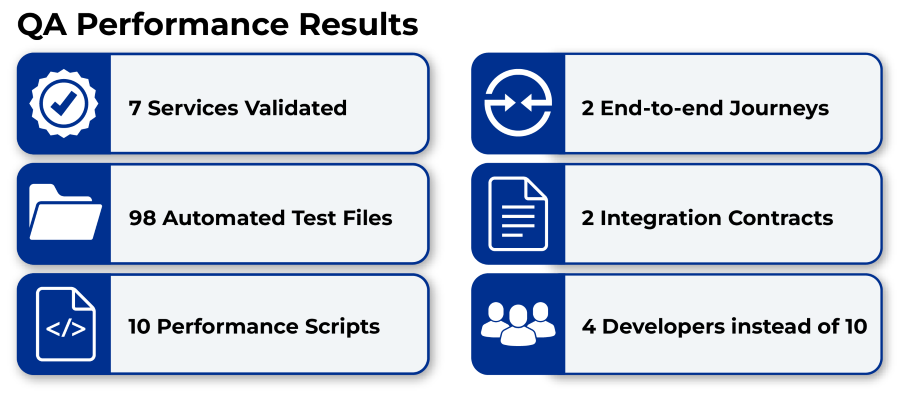
QA ran continuously alongside development. While one phase was being built, the previous phase was being tested. No build was promoted to production until it passed 100 percent.
Quality That Extended Beyond the Project
The testing produced value beyond the project’s own scope. These services had to exchange data with systems across the company, so the integration tests continually verified that those connections were working as expected. When something on the other end was out of date or not responding correctly, the tests surfaced it, and the team passed it along to the group that owned that system. Work scoped to one product ended up giving other teams visibility they would not have had otherwise.
The Delivery
Development began in late January 2026. The originally planned minimum viable product (MVP), took five months. Each phase delivered a working service. That scope wrapped in early June, ahead of schedule because the team moved so quickly. This allowed the customer to extend the project by four more phases to add enhancements to the services already built. That final work concluded in August 2026.
The Results
AI-accelerated delivery shortened the timeline by 79%. Work that traditional methods would have stretched 18-24 months was delivered in five months, and the customer brought a market-expanding payments capability to its childcare product in time for the school season.
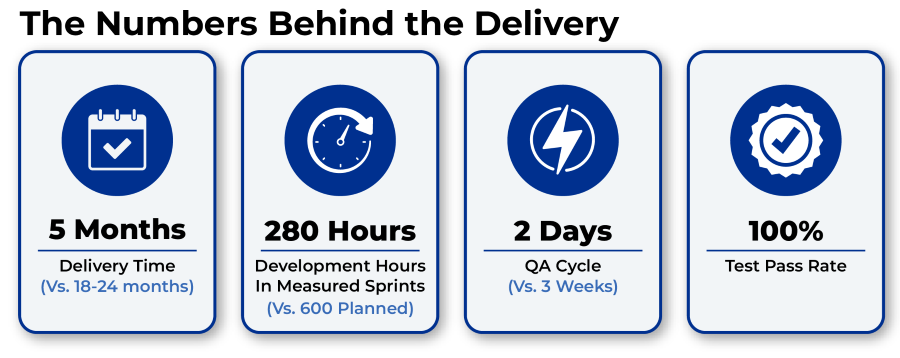
The effort savings were tracked, not estimated after the fact. Since logging AI development time is difficult, the team estimated each task in traditional human hours and then recorded the hours actually spent. In the sprints measured this way, 600 hours of planned human effort were completed in 280. At the task level, the gap was often wider: one piece of work estimated at 34 developer hours was finished in about two.
The same compression showed up in team size. Building seven services on this timeline would traditionally require a team of ten senior developers. It was done with five people, one technical lead, two developers, and two QA professionals. This AI-accelerated, spec-driven approach is designed to scale, making it just as effective for larger teams or more complex projects. The frameworks and processes established here can support bigger initiatives, ensuring that speed, quality, and accountability are maintained as requirements and teams grow.
Quality moved just as fast. A QA cycle that traditionally takes three weeks was completed in two days. After each deployment, the team had full test results back in 10 to 15 minutes, with a report identifying exactly which scenario failed. Load testing put 1,000 users on a single test instance at once with no degradation, equivalent to a million transactions per hour in production. No build reached production until it passed 100 percent of its tests in every environment.
A New Way of Working
The most durable outcome was not the platform. It was proof that AI can be applied across the entire software development lifecycle, not just to writing code.
AI helped draft the specifications. AI generated the code. AI ran the testing. AI accelerated the bug fixing that followed. At every stage, a person directed the work, reviewed the output, and made the decisions, and the work moved faster than it would have otherwise. That full-lifecycle model is what the customer proved out here, on a financial ledger, where being exactly right is a requirement.
The requirements practice changed permanently. Specifications are no longer written as documents that circulate for sign-off. They are written as version-controlled files, reviewed and approved the same way engineers review code, and the customer has adopted that approach across the organization.
Measurement changed too. Sprint reports now compare estimated human effort against actual AI-assisted hours so that leadership can see the return in a form it can act on.
This was the customer’s first applied AI project. It will not be the last.
Changing What’s Possible with Diamond AI Solutions
This project showed that progress can happen much faster than before. QAT Global delivered in five months instead of 18-24, without sacrificing quality, governance, or human accountability. AI didn’t replace the engineering team. Engineers used it to accelerate the work, pairing AI speed with their own expertise to build, test, and ship the platform.
This is what Diamond AI offers. It brings together AI speed with engineering expertise, strong governance, and a Human-in-the-Loop approach. This helps organizations turn ideas into real business results. The benefits went beyond faster development. QAT Global’s customer was able to add a new feature to their product before the school season, cut down on engineering work, speed up quality checks, and create a new way of working that others have now adopted too.
This is how Diamond AI can deliver business value. You do not have to choose between speed and accountability. With Diamond AI, organizations can build new or modernize their applications quickly, without giving up quality or governance. This leads to better business results, faster. Progress no longer has to wait.
To learn more about QAT Global’s Diamond AI Solutions, visit QAT.ai