Skip to content

P: +1 (800) 799 8545

E: qatcommunications@qat.com

  • Client Portal
  • Employee Portal

P: +1 (800) 799 8545 | E: sales[at]qat.com

QAT Global
  • What We Do

    Custom Software Development

    We build custom software with Quality, Agility, and Transparency to drive your business success.

    Engagement models.

    Access onshore and nearshore custom software development experts with engagement models tailored to fit your project needs.

    IT Staffing

    Client-Managed Teams

    Managed Teams

    Services

    Artificial Intelligence (AI)

    Cloud Computing

    Mobile Development

    DevOps

    Software Modernization

    Internet of Things (IOT)

    UI/UX

    QA Testing & Automation

    Technology Consulting

    Software Development

    View all >

    Technologies

    Agile

    AI

    AWS

    Azure

    DevOps

    Cloud Technologies

    Java

    JavaScript

    Mobile

    .NET

    View all>

    Industries

    Tech & Software Services

    Utilities

    Transportation & Logistics

    Payments

    Manufacturing

    Insurance

    Healthcare

    FinTech

    Energy

    Banking

    View all >

  • Our Thinking
    • QAT Insights Blog
    • Tech Talks
    • Resource Downloads
  • Who We Are
    • About QAT Global
    • Meet Our Team
    • Our Brand
  • Careers
  • Contact Us
Let’s Talk
QAT Global - Your Success is Our Mission
  • Ways We Help
    • Custom Software Development
    • IT Staffing
    • Dedicated Development Teams
    • Software Development Outsourcing
    • Nearshore Software Development
  • ServicesCustom Software Development Services Solutions Built to Fuel Enterprise Success and Innovation Explore QAT Global’s custom software development services, offering tailored solutions in cloud, mobile, AI, IoT, and more to propel business success.
  • Technology Expertise
  • Industries We ServeInnovate and Lead with Our Industry-Specific Expertise Leverage our targeted insights and technology prowess to stay ahead in your field and exceed market expectations.
  • What We Think
    • QAT Insights Blog
    • Downloads
  • Who We Are
    • About QAT Global
    • Meet Our Team
    • Omaha Headquarters
    • Careers
    • Our Brand
  • Contact Us

QAT Insights Blog > The Top 9 Legacy Modernization Drivers

QAT Insights

The Top 9 Legacy Modernization Drivers

Bonus Material: Free E-Book – What are Your Legacy Systems Really Costing You?

Legacy systems hinder agility, innovation, and integration, making modernization essential for organizations looking to stay competitive. QAT Global helps businesses modernize by addressing critical drivers like data management, platform migration, and code complexity, ensuring long-term efficiency and adaptability.

17.6 min read| Last Updated: January 13, 2025| Categories: Software Reengineering & Support|

The Top 9 Legacy Modernization Drivers for Enterprise Organizations

Legacy systems create roadblocks that impede digital business transformation, obstructing an organization’s agility in responding to market demands, innovating solutions, and strengthening their competitive edge.

One thing is clear: technology is evolving rapidly right before our very eyes. Every aspect of our lives and the society we live in is touched by these changes. There’s no sign of a slowdown in sight. The microcosm of software development is experiencing the same thing. Organizations require speedier development philosophies to get their services and products to market faster than ever to remain competitive and relevant in the marketplace.

Business agility is the new source of business value.

We’ve known this day was coming for a long time. As developers faced the turn of the century, they started to question and criticize the popular processes and assumptions at the foundation of their field. Concepts like Waterfall development methods, having highly detailed requirements before starting development, and designing comprehensive architectures came under fire. In the mid-1990s, a small group of thought-leaders worked on approaches to the development designed for speed and change. The term “agile software development” emanated from this group in 2001, launching the software development microcosm into a new era. Since then, the agile philosophy has become the best-practices standard for software development.

As mainframe developers experienced with procedural languages retire at increasing rates, and the cost of maintaining the mainframe rises steadily, organizations are justifiably nervous about the future. These organizations need a strategy that embraces agile development and the cloud, yet balances with mainframe environments until a full modernization of their systems can be completed.

Some organizations are looking to a bimodal IT strategy to solve their problems. Under a bimodal strategy, the organization essentially runs two IT organizations, one mired in the old ways and one pursuing the new. While executing a bimodal strategy can be done and may help an organization manage key systems while adopting new, more efficient development techniques, it is rather complex and costly. The strategy essentially leaves the organization with two IT camps competing for limited resources, yet needing to work closely together. This strategy is designed for the short term; it’s not a strategy you would want to rely on permanently. It’s critical to transform the legacy environment, instead of adapting your methodologies to it, to ensure your organization can meet the requirements of the business and competitive demands of the market moving forward.

Legacy modernization efforts are being driven by specific business outcomes even as business and IT departments both strive to extend the life of existing applications while bringing additional functionality and value to the organization.

Business operations, risk management, and business growth are key driving forces for modernization efforts rather than simply seeking cost reductions from getting off a mainframe. The focus on business outcomes enables IT and the organization to focus their time and investments where the business outcomes are greatest and yet prioritize their modernization initiatives using a portfolio strategy.

“Three out of four Federal IT managers (77%) say application modernization will improve the end-user experience at their agency. “ MeriTalk – Future Ready Applications: The Modern Legacy https://www.meritalk.com/study/future-ready-applications/

The Challenge of Legacy Systems

The legacy systems found in most organizations have been in place for decades now and were frequently built to serve a single purpose. The result is that they rarely meet the criteria necessary to help an organization in the long term. In addition, the existing applications that match yesterday’s business models are not easily changed to meet the ever-changing business climate.

These legacy systems are perpetuating a variety of business challenges including:

  • Disjointed development and maintenance, resulting in “silo-based” use
  • Runtime, maintenance, and staffing costs are high and growing
  • Architecture makes business intelligence efforts either prohibitive or completely impossible
  • Design makes it difficult or impossible to change or adopt a new business model
  • Application resistance to change results in compliance and regulatory challenges
  • System design has created an inability to share data between internal and external systems
Download Our Legacy Modernization Guide

DevOps: Agile for Everyone

As organizational leaders experienced the successes that Agile brought to the development world, they questioned if it could be expanded to include the operational side of the house. From this, DevOps came into being.

DevOps is more than a methodology; it’s an organizational culture that requires an updated approach to the ways the organization processes data. Development teams and Operations work together from the beginning to develop and test software. The result is a straight line from start to finish; the rework seen on a traditional ops chart is avoided. Essentially, DevOps is agile development for IT and Operations, in concert with one another.
DevOps can provide a competitive advantage during software modernization efforts.

Top 9 Legacy Modernization Drivers: Compelling Reasons in the Organization

The following are typical legacy modernization drivers that compel business and IT managers to explore modernization strategies:

1. Managing Explosive Data Consumption

Managing Explosive Data Consumption – With the advent of the smartphone, individuals are producing and consuming far more data than at any time in history, and it’s only expected to continue to increase. Even our homes, cars, and appliances are consuming and producing data through internet connectivity. In fact, according to the 2015 IBM Cyber Monday Report, mobile traffic accounted for 47.9% of all online traffic, up 16.3% over 2014. Juniper Research has also predicted 195 billion mobile commerce transactions will be made annually by 2019 by mobile phone and tablet users, up from 72 billion this year, which is about 197 million transactions per day. In addition, mobile data traffic generated by devices like tablets, smartphones, and other feature phones will reach almost 197,000 petabytes by 2019, according to analysts at Juniper Research. Cisco research supports their findings and predicts that overall mobile data traffic is expected to grow to 30.6 exabytes per month by 2020, a stunning eightfold increase over 2015. Impacts of these trends can be clearly seen in the financial industry where KPGM research forecasts that global mobile banking will see exponential growth over the next 5-10 years further fueling a need to focus on a mobile first strategy within the industry.

Meeting the performance demands of this connected universe is proving to be a challenge in mainframe environments already. When integrating new applications with their older mainframe technology, organizations are seeing a great deal of complexity added to their application delivery chain. With this added complexity comes increasing costs. As data consumption continues to escalate at the dramatic rates predicted, finding lower-cost, more extensible, and more service-oriented alternatives to their legacy systems will be critical for the survival of organizations across industries.

The Internet of Things (loT) is on the rise. By 2020, 30 billion devices are expected to be connected to the Internet, and 40 trillion GB of data is expected to be created. – IDC Predictions 2012: Competing for 2020, Document 231720, December 2011, Frank Gens.

2. Eliminating Repetitive, Disconnected Systems and Improving Integration

Eliminating Repetitive, Disconnected Systems and Improving Integration – Certain industries depend on interconnected data from disparate or diverse parts of the organization to maintain efficiencies and grow competitive advantage making integration one of the main business drivers of organizations considering legacy modernization. In addition, similar functionality exists on and off the legacy stack in many organizations, creating dual maintenance scenarios. For example, according to benchmark data collected by CSC, “a typical mid-to-large U.S. insurer maintains four or more policy admin systems, and many have portfolios of 10 or more systems .” Also, some multinationals have redundant platforms across countries or regions, due to acquisitions and/or governance of each region as a standalone profit center. Other business forces driving the need for integration include factors such as the need to streamline business processes or new business partnerships.

Organizations need to be able to reuse data to avoid recreating or redoing work that’s already been done to optimize their processes and ROI.
There are two types of application integration of importance to most organizations:

  • Tightly coupled applications
  • Interoperable applications

Interoperable applications are the most frequent type of integration style. The goal is to get diverse applications working together to help the organization achieve its business goals. In today’s business environment, interconnection requirements are standard, and the reusability of data is often a top priority.
Reusability, if possible at all, is extremely limited without adequate interfaces to link systems. Legacy applications were simply not designed for this. Older applications are typically highly complex, poorly architected solutions with custom hard-coded interfaces written with limited functionality in mind, making integrating legacy systems very difficult. This keeps existing silos in existence and prevents sharing of information across the organization and between organizations. In fact, integration and reusability may be impossible for organizations wishing to remain in a legacy state without major time and money investments and potentially serious risk to current systems.

On the business side, legacy systems were designed with usability as a secondary consideration since they were internally facing and often come with hard-to-learn interfaces and overall lack of functionality. The result is that business users often spend more time trying to figure out the system or avoid using it altogether, opting instead to manually complete required tasks. This not only costs time and increases employee frustration, but when employees revert to manual processes, information access and security become major concerns.

3. Gaining Agility and Cost Savings with Platform Migration

Gaining Agility and Cost Savings with Platform Migration – Many organizations look to move away from mainframe-based solutions to distributed environments for cost savings and agility reasons. In many cases, distributed platforms offer a lower cost alternative to the mainframe, as well as a more flexible infrastructure, including J2EE and .NET. Organizations are also reviewing their platform strategies as their need to use technologies such as Service Oriented Architectures (SOA) and Web services to improve their agility increases. Changing platforms isn’t a quick process, making a modernization strategy that supports having applications co-existing in more than one environment a common necessity.

4. Compliance and Regulatory Requirements

Compliance and Regulatory Requirements – For an organization to meet their process compliance requirements, stemming from legislated standards such as Sarbanes-Oxley, HIPAA in the U.S., and BASEL II in Europe, they need the ability to extract business processes from their legacy systems, document those processes, and then transform those processes into new modern solutions. They also need to be able to regularly upgrade their software and operating systems to stay current with security patches and to ensure that all software in use within the organization is continuously supported. Failing to do so or continuing to use unsupported software can be viewed as negligence.

In many cases, legacy systems have been updated over the years with relatively minimal testing and release note documentation by staff no longer with the organization. When organizations look to update or customize their systems, they can easily generate an operating deficiency — a serious issue for organization subject SOX. If a control is not operating as it should or there is a technical fault present in any systems directly involved with the administration of an organization’s finances, and official support is no longer available, the change can put the organization at risk of a serious SOX violation. As it is C-level management that must bear the legal consequences of these types of SOX violations, modernization should be a major concern of theirs.

6. Reducing Code Complexity

Reducing Costs – The pressure from investors, boards, and management to reduce operating costs is a significant driver for many modernization efforts. Many legacy environments, including mainframes, are expensive to operate in terms of hardware infrastructure, software license fees, and maintenance staff. There is an urgency to move to what are perceived as more cost-effective platforms. Cost reductions can also be achieved by moving applications to modern development environments that bring with them improved developer productivity and reductions in system maintenance costs.

According to the US Department of Defense, in 2014 their average mainframe per hour spend was $499.98, a shocking sixteen times the cost of running an equivalent environment similar performance characteristics on a Linux platform. The future outlook is dim with IT industry analysts estimating that most large organizations utilizing mainframes should expect 15–20% annual increases in their systems’ CPU resource consumption. With mainframe usage fees making up nearly 10% to 40% of an organization’s IT budget according to a study commissioned by Infosys, cost savings is naturally a motivating force behind many organization’s legacy modernization projects.

Not only is a cloud-based virtual infrastructure’s cost lower, but its usage model is also the opposite of the mainframe’s. The cost model used in the mainframe world is based on peak utilization: businesses pay a rate tied to the peak usage a system achieves over a billing period, even if that maximum is momentary. In a cloud-based environment, organizations typically pay for usage on a utilization basis and have total control over consumption of computing power in their control dashboard. In moving off the mainframe, organizations benefit from the change in billing model as well.

“Federal agencies spend 79% of their IT budgets or $62B annually on legacy systems. “MeriTalk, “Innovation Inspiration: Can Software Save IT?” 7/23/13

Reducing Code Complexity – Legacy systems have typically been modified countless times by many different developers over the years, resulting in code that is very complex and inflexible, known as spaghetti code. These systems take a very long time to modify and in many cases cannot be changed. Organizations need a way to move these legacy systems into an environment where they can be updated and maintained quickly and easily.

7. Increasing Speed to Market / Agility to Adapt

Increasing Speed to Market / Agility to Adapt – Organizations require agility to grow and respond to the marketplace. Rapid development and deployment of business software and software products is key to this agility. Many enterprise systems in production today were written three to five decades ago and were not architected or coded for flexibility and easy maintenance. Just as the demands the organization places on the software have evolved over time, so has our understanding of application development best practices.

As you look to transition these old mission-critical applications to modern technologies and architectures, you must first extract the business rules hidden in the code. Being able to reuse key components from legacy applications can provide organizations with a significant competitive advantage during this time of transition.

8. Leveraging Technology Developments

Leveraging Technology Developments – Developments in technology are occurring at a rate faster than ever before; organizations are continuously under pressure to assess these developments and leverage those technologies that will benefit their organization in their software applications. Many organizations need to modernize their rigid legacy applications to more flexible web infrastructures that will enable them to be more competitive and provide customers with better service. Other organizations have legacy application integration needs that require the use of Web service technologies and Service Oriented Architectures. As technology gets more sophisticated and organizations grow increasingly dependent on their core business systems, it is imperative that they ensure that this software is flexible and maintainable.

9. Preparing for a Change in Technological Skills and Business Knowledge

Preparing for a Change in Technological Skills and Business Knowledge – A mainframe systems skills shortage has been widely anticipated as increasing numbers of developers from the baby boomer generation opt to retire. According to analysts at Forrester and Gartner, tens of thousands of COBOL programmers retire every day, a trend which is expected to continue beyond 2019. Many organizations have found themselves very dependent on their core mainframe programmers for insight, understanding, and maintenance of key business applications that have been updated countless times over the years and have been in production for decades. Vast numbers of these applications are extremely complex, have no documentation, and there are few, if any, developers left with any understanding of the business rules embedded in the code. Modernizing these legacy systems into an environment that can be understood and maintained by non-mainframe skilled developers and system analysts is imperative to the future of these organizations before the skills shortage reaches a crisis level.

Modernize to support competitive differentiators like cloud, mobile, and big data analytics.
Improve customer service
Fuel innovation
Create new business value
Increase compliance

10. Eliminating Repetitive, Disconnected Systems and Improving Integration

Eliminating Repetitive, Disconnected Systems and Improving Integration – Certain industries depend on interconnected data from disparate or diverse parts of the organization to maintain efficiencies and grow competitive advantage making integration one of the main business drivers of organizations considering legacy modernization. In addition, similar functionality exists on and off the legacy stack in many organizations, creating dual maintenance scenarios. For example, according to benchmark data collected by CSC, “a typical mid-to-large U.S. insurer maintains four or more policy admin systems, and many have portfolios of 10 or more systems .” Also, some multinationals have redundant platforms across countries or regions, due to acquisitions and/or governance of each region as a standalone profit center. Other business forces driving the need for integration include factors such as the need to streamline business processes or new business partnerships.

Organizations need to be able to reuse data to avoid recreating or redoing work that’s already been done to optimize their processes and ROI.
There are two types of application integration of importance to most organizations:

  • Tightly coupled applications
  • Interoperable applications

Interoperable applications are the most frequent type of integration style. The goal is to get diverse applications working together to help the organization achieve its business goals. In today’s business environment, interconnection requirements are standard, and reusability of data is often a top priority.
Reusability, if possible at all, is extremely limited without adequate interfaces to link systems. Legacy applications were simply not designed for this. Older applications are typically highly complex, poorly architected solutions with custom hard-coded interfaces written with limited functionality in mind, making integrating legacy systems very difficult. This keeps existing silos in existence and prevents sharing of information across the organization and between organizations. In fact, integration and reusability may be impossible for organizations wishing to remain in a legacy state without major time and money investments and potentially serious risk to current systems.

On the business side, legacy systems were designed with usability as a secondary consideration since they were internally facing and often come with hard-to-learn interfaces and overall lack of functionality. The result is that business users often spend more time trying to figure out the system or avoid using it altogether, opting instead to manually complete required tasks. This not only costs time and increases employee frustration, but when employees revert to manual processes, information access and security become major concerns.

“92 percent of Federal IT managers say that it’s urgent for their agency to modernize legacy applications, citing the largest driving factors as security issues (42%), time required to manage/ maintain systems (36%), inflexibility (31%), integration issues (31%), innovation hindered (30%), and the difficulty finding staff with experience managing/maintaining legacy systems (29%).” MeriTalk – Future Ready Applications: The Modern Legacy https://www.meritalk.com/study/future-ready-applications/

Opportunity

If your enterprise is like most, you have a variety of platforms that span decades of technology innovations; from the mainframe to the cloud. Staying with this style of IT environment is both costly and stifling; it limits you from innovating and growing your organization. Legacy modernization is the preferred solution to this situation.

“Reboot” your IT portfolio through modernization for greater business and system agility, operational excellence, and cost minimization. This frees up your time and money to focus on innovation, not technical implementation.

Modernizing your legacy applications is about leveraging their value, reusing embedded business rules and intellectual property, and transforming them to more modern architectures, technologies, and designs. There are virtually as many approaches to modernization as there are drivers compelling an organization to take this strategic step for their organization. Each approach has various pros/cons and results. It is critical to understand each of these approaches and how QAT Global’s recommended approach results in the strongest outcomes for modernizing your mission-critical legacy applications.

Benefits

Mainframe Migration Aligns with CIO Imperatives

  • Cost Reduction – Infrastructure Modernization
    • Scalability at a fraction of mainframe cost
    • Simpler operations
    • Broader choices, a strong cost-benefit ratio, and greater budget flexibility
  • Speed Up Business – Innovation, Agility
  • IT Simplification – Virtualization, Cloud

Our Legacy Renewal Solution enables organizations to:

  • Extract and reuse their key business rules from the legacy code
  • Document these business rules and processes as they are extracted from the legacy code
  • Make improvements to the extracted business rules to optimize processes in the modernized system
  • Modernize the system to a new platform and architecture
  • Future-proof their modernized solutions from future advances in technology
  • Realize time, cost, and risk reductions typically associated with legacy modernization

Federal IT managers say the top deciding factors they use when prioritizing which applications to modernize include:
#1 Security risks
#2 Mission criticality
#3 Technical adequacy
#4 Widespread use of application
#5 TCO
MeriTalk – Future Ready Applications: The Modern Legacy https://www.meritalk.com/study/future-ready-applications/

Take the Steps for Success

Ready to start on the path to modernizing your software with a practical approach? Using an Agile modernization approach with proper planning and the right people on your team will put you on the path to success. The development team at QAT Global is experienced in modernizing legacy applications and working with clients who have complex environments. Put your next modernization project on the path to success, start the conversation with our development team today.


Free E-Book – What are Your Legacy Systems Really Costing You?

Share This Story, Choose Your Platform!

Jump to Section:
  • The Top 9 Legacy Modernization Drivers for Enterprise Organizations
  • The Challenge of Legacy Systems
  • DevOps: Agile for Everyone
  • Top 9 Legacy Modernization Drivers: Compelling Reasons in the Organization
  • Opportunity
  • Benefits
  • Take the Steps for Success
QAT Global - Your Success is Our Mission

At QAT Global, we don’t just build software—we build long-term partnerships that drive business success. Whether you’re looking to modernize your systems, develop custom solutions from scratch, or for IT staff to implement your solution, we’re here to help.

Your success is our mission.

BBB Seal

GoodFirms Badge - QAT Global - Omaha, NE

new on the blog.
  • AI Data Quality Mistakes That Sabotage Your AI Strategy

    AI Data Quality Mistakes That Sabotage Your AI Strategy

  • From Guessing to Knowing: How Retrieval-Augmented Generation (RAG) Builds Trustworthy Enterprise AI

    From Guessing to Knowing: How Retrieval-Augmented Generation (RAG) Builds Trustworthy Enterprise AI

  • How to Leverage Agentic AI to Transform Enterprise Software

    How to Leverage Agentic AI to Transform Enterprise Software

  • SAFe vs Scrum: The Ultimate Guide to Choosing the Right Agile Framework for Your Project

    SAFe vs Scrum: The Ultimate Guide to Choosing the Right Agile Framework for Your Project

ways we can help.
Artificial Intelligence
Custom Software Development
IT Staffing
Software Development Teams
Software Development Outsourcing
connect with us.
Contact Us

+1 800 799 8545

QAT Global
222 South 15th Street, Suite 405N
Omaha, NE 68102

(402) 391-9200
qat.com

follow us.
  • Privacy Policy
  • Terms
  • ADA
  • EEO
  • Omaha, NE Headquarters
  • Contact Us

Copyright © 2012- QAT Global. All rights reserved. All logos and trademarks displayed on this site are the property of their respective owners. See our Legal Notices for more information.

Page load link

Explore…

Services
  • Artificial Intelligence (AI)
  • Cloud Computing
  • Mobile Development
  • DevOps
  • Application Modernization
  • Internet of Things (IOT)
  • UI/UX
  • QA Testing & Automation
  • Technology Consulting
  • Custom Software Development
Our Work
  • Case Studies
Ways We Help
  • Nearshore Solutions
  • IT Staffing Services
  • Software Development Outsourcing
  • Software Development Teams
Who We Are
  • About QAT Global
  • Meet Our Team
  • Careers
  • Company News
  • Our Brand
  • Omaha Headquarters
What We Think
  • QAT Insights Blog
  • Resource Downloads
  • Tech Talks
Industries We Serve
  • Life Sciences
  • Tech & Software Services
  • Utilities
  • Industrial Engineering
  • Transportation & Logistics
  • Startups
  • Payments
  • Manufacturing
  • Insurance
  • Healthcare
  • Government
  • FinTech
  • Energy
  • Education
  • Banking
Technologies

Agile
Angular
Artificial Intelligence
AWS
Azure
C#
C++
Cloud Technologies
DevOps
ETL
Java
JavaScript
Kubernetes
Mobile
MongoDB
.NET
Node.js
NoSQL
PHP
React
SQL
TypeScript

QAT - Quality Agility Technology

Your Success is Our Mission!

Let’s Talk
QAT Global

Legacy Modernization Guide

What Are Your Legacy Systems Really Costing You?

Discover the hidden costs and unlock the potential of modernization for a more efficient and secure future.

Yes! I Want My Free E-Book
Legacy Modernization

Love this article? Don’t miss the next one!

Sign up for our newsletter for free guides, articles, and tips to power business and personal success.

This field is for validation purposes and should be left unchanged.
This field is hidden when viewing the form
Name
Consent(Required)
QAT Global

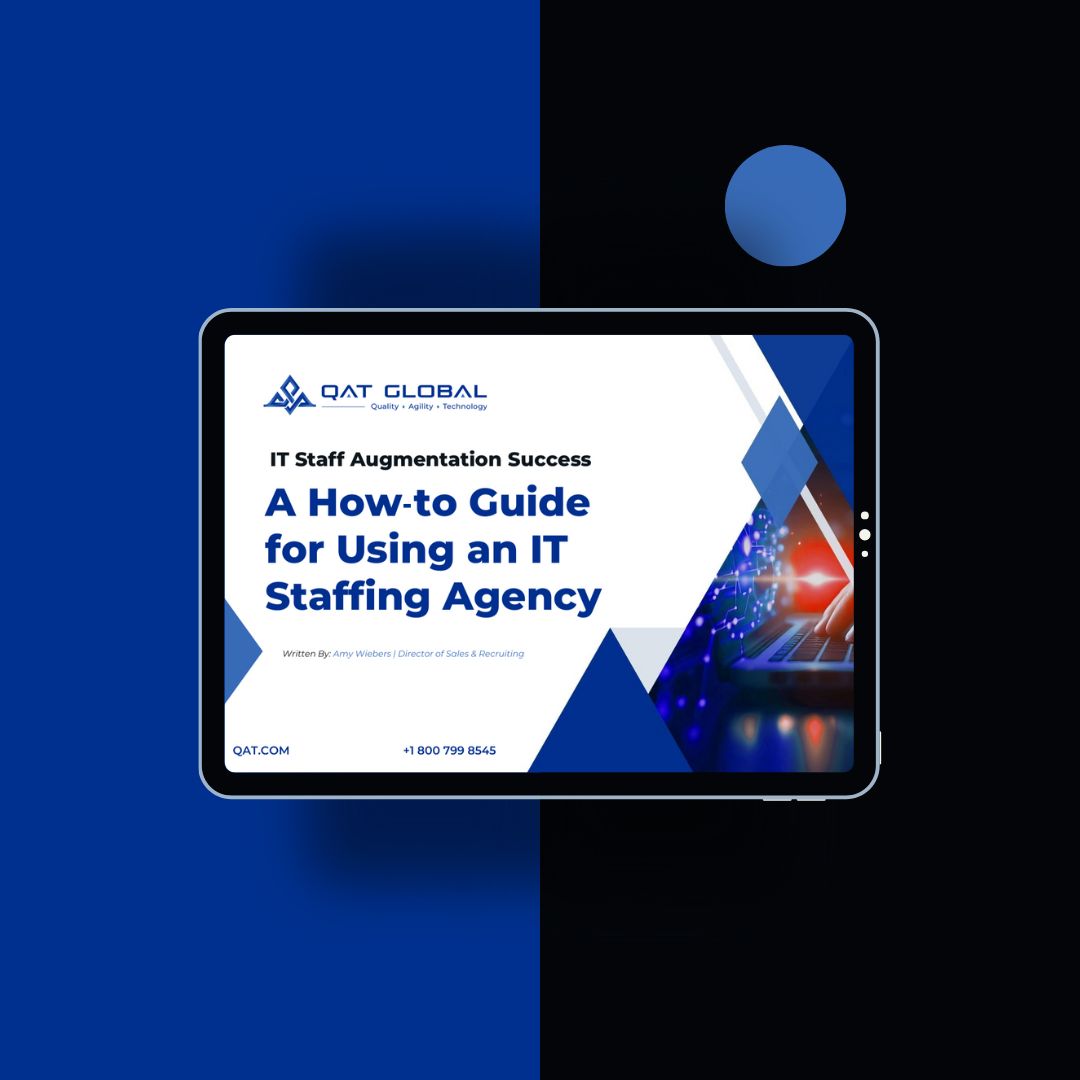
IT Staff Augmentation Success: A How-to Guide for Using an IT Staffing Agency

Get proven best practices for IT staff augmentation success. Learn how to use an IT staffing agency to source, vet, & support top tech talent.

Yes! I Want My Free E-Book
A How to Guide for Using an IT Staffing Agency
QAT Global

Ultimate Guide to Software Requirements Specifications

Gain expert insights into building effective SRS that help you avoid common pitfalls, streamline the development process, and deliver software that meets both stakeholder and user expectations.

Yes! I Want My Free E-Book
Software Requirements Specifications
QAT Global

Unlock the Secrets to Effective Team Management in the Age of Remote Work

This comprehensive guide is your key to fostering collaboration, boosting productivity, and achieving success in a remote work environment.

Yes! I Want My Free E-Book
Remote Work Team Management
QAT Global

The Ultimate Guide to Project Outsourcing

Discover The Power of Project Outsourcing For Business Success

Dive deep into the world of outsourcing and discover how it can be a game-changer for your business.

Yes! I Want My Free E-Book
Project Outsourcing
QAT Global

Unlock the Future of Mobile Technology

Discover how Progressive Web Apps are transforming enterprise mobility and bridging the gap between web and mobile.

Yes! I Want My Free E-Book
Mobile Revolution
QAT Global

Guide to Nearshore IT Staffing

Unlock Power of Nearshore IT Staffing Solutions

Discover cost-effective strategies and gain a competitive edge with expert nearshore staffing solutions.

Yes! I Want My Free E-Book
Nearshore IT Staffing Solutions
QAT Global

Guide to Strategic IT Staffing Solutions

Navigate the Future of IT Staffing with QAT Global

Explore the complexities and opportunities of IT staffing and learn about the evolution of IT staffing, the benefits of tailored solutions, and how QAT Global’s unique approach can help your organization thrive.

Yes! I Want My Free E-Book
Strategic IT Staffing Solutions
QAT Global

Strategic Nearshoring Guide

Transform Your Enterprise with Strategic Nearshoring

Discover how nearshore IT staffing drives agility, innovation, and cost efficiency in the digital age.

Yes! I Want My Free E-Book
Strategic Nearshoring Guide
QAT Global

Harness Innovation with Open Source Software

Discover how open source is revolutionizing enterprise organizations and driving digital transformation. Learn best practices for addressing security concerns, leveraging community collaboration, and navigating compliance.

Yes! I Want My Free E-Book
Open Source Software in Enterprise Organizations
QAT Global

Navigate the Ethical Implications of Big Data

Unlock insights from our executive briefing and learn strategies for addressing privacy concerns, maintaining ethical integrity, and navigating compliance in a data-driven world.

Yes! I Want My Free E-Book
Ethical Implications of Big Data
QAT Global

Achieve Business Growth Through Digital Transformation

Discover how top organizations are driving efficiency, improving customer experiences, and fueling growth with proven strategies for success.

Yes! I Want My Free E-Book
Digital Transformation