The Planning Pattern: Why Enterprise AI Needs Structure Before Execution
As AI systems move from exploration to execution, adaptability alone stops being enough. Enterprises need AI agents that can understand complex objectives, break them into manageable steps, coordinate work across systems and teams, and execute predictably within constraints. The planning pattern provides exactly that structure.
Here’s what organizations learn when agents move beyond single tasks: the difference between AI that impresses in demos and AI that delivers in production is planning. Not because planning is sophisticated, but because enterprise environments demand predictability, and predictability requires structure that exists before execution begins.
If your AI initiative involves multi-stage work, dependencies between steps, or coordination across systems, the planning pattern isn’t optional. It’s foundational.
What Planning Actually Does
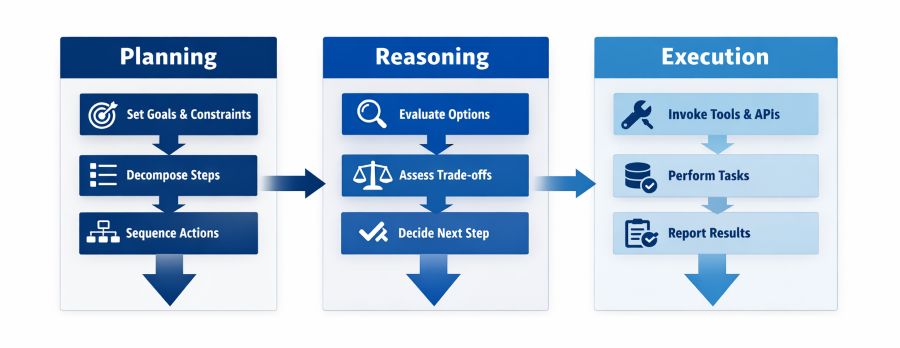
The planning pattern enables an AI agent to analyze a goal, decompose it into smaller tasks, identify dependencies between those tasks, and sequence execution before taking any action.
Rather than reacting step by step or discovering the path through trial and error, the agent clarifies the objective, identifies required subtasks, determines execution order and dependencies, selects appropriate tools or resources for each step, and then executes the plan with structure intact.
This mirrors how enterprise teams manage complex projects. Planning introduces foresight, structure, and intent into agentic workflows—qualities that separate production systems from experiments.
Why Enterprise Environments Demand Planning
Enterprise environments are defined by constraints that pilots often ignore. Deadlines that can’t be negotiated away. Budgets that track every API call and compute hour. Compliance requirements that demand audit trails. System dependencies where order of operations matters. Human coordination where timing affects availability and outcomes.
Planning allows AI agents to operate within those constraints instead of discovering them too late, after resources are wasted or compliance is violated.
Gartner’s prediction that by 2028, 33% of enterprise software applications will include agentic AI (up from less than 1% in 2024) suggests that successful implementations will be those that combine autonomous capability with structured execution—exactly what planning provides.
Without planning, agents act opportunistically, miss critical dependencies, duplicate work across parallel efforts, and create cascading failures when assumptions prove wrong.
With planning, execution becomes intentional rather than reactive, dependencies are identified and respected, progress becomes measurable against defined milestones, and risks surface early when they can still be managed.
This fundamental difference is why planning appears in virtually every enterprise-scale agentic system that survives contact with production.
Where Planning Delivers Enterprise Value
Multi-Step Business Processes
Agents plan sequences such as intake, validation, approval, execution, and reporting rather than treating each step as an isolated action without context of what comes before or after.
Software Development and Delivery
Agents decompose features into requirements gathering, design tasks, implementation steps, testing phases, and deployment activities while respecting technical dependencies and team availability.
Data and Analytics Pipelines
Agents plan extraction, transformation, validation, and analysis steps before touching production data, ensuring data quality gates are respected and downstream dependencies are satisfied.
Cross-System Workflows
Agents coordinate actions across CRM, ERP, finance, and support systems while understanding that order matters—you can’t fulfill an order before validating inventory, or invoicing a customer before confirming delivery.
McKinsey’s November 2025 State of AI report found that organizations achieving enterprise-level EBIT impact from AI are those redesigning workflows rather than simply adding AI to existing processes. Planning patterns enable that workflow redesign by making dependencies and sequences explicit.
In these scenarios, planning doesn’t just improve efficiency. It prevents operational chaos that undermines trust in AI systems.
Planning vs ReAct: Understanding When Each Pattern Applies
Planning and ReAct solve fundamentally different problems, and organizations that succeed with both understand when to apply each.
Planning excels when the goal is clearly defined, dependencies between steps are known or discoverable in advance, the environment is relatively stable during execution, and errors carry significant cost that justifies upfront structure.
ReAct excels when information must be discovered through interaction, conditions change frequently enough that rigid plans become obsolete, the optimal path forward is genuinely uncertain, and the cost of exploration is lower than the cost of detailed planning.
Enterprises often need both patterns in the same system. The mistake organizations make is treating planning as obsolete because ReAct feels more modern or flexible.
In reality, planning provides the structural backbone that makes adaptability safe. ReAct handles uncertainty within a planned framework, rather than replacing structure entirely.
Where Planning Breaks Down (And What That Teaches Us)
Planning is not a silver bullet, and understanding its failure modes helps enterprises use it appropriately. Common limitations include plans becoming outdated as business conditions change faster than replanning cycles, overly rigid execution that ignores valuable new information emerging during work, excessive upfront planning for straightforward tasks where the overhead exceeds the value, and false confidence in predicted outcomes when the planning process doesn’t account for genuine uncertainty.
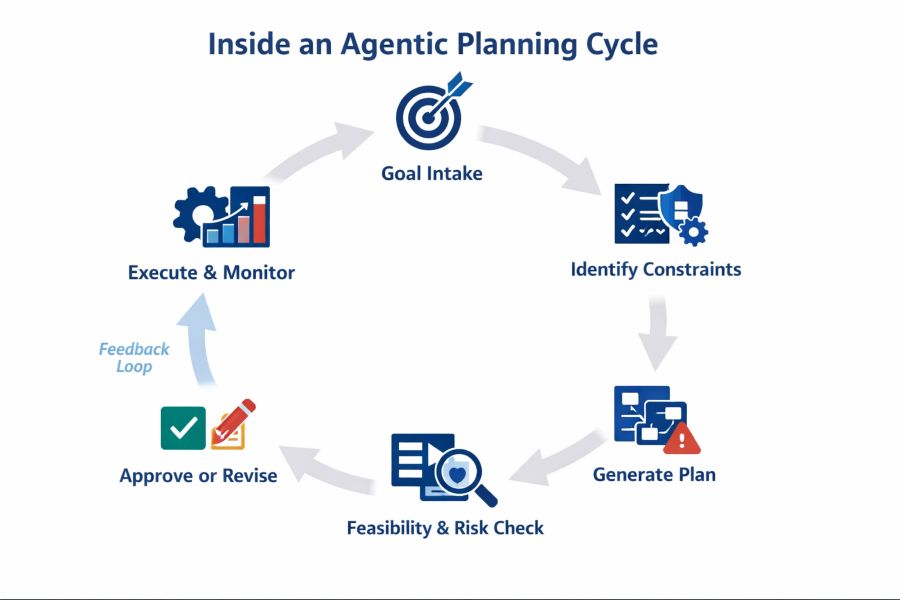
These failures occur when planning is treated as a one-time activity that produces a fixed artifact, rather than as a continuous process that evolves with understanding.
Gartner’s research on AI agent development frameworks emphasizes that successful enterprise implementations combine planning with memory management to maintain context, tool use to execute planned steps, and the ability to adapt when plans encounter reality.
How Modern Planning Actually Works: Adaptive Planning
Modern agentic systems rarely rely on static plans that can’t change once execution begins.
Adaptive planning allows agents to revisit and revise plans mid-execution when new information emerges, insert or remove steps as understanding improves, escalate to humans when foundational assumptions prove incorrect, and switch to ReAct-style exploration when the planned approach clearly isn’t working.
This hybrid approach preserves structural benefits of planning without sacrificing the responsiveness that complex environments demand.
The organizations succeeding with agentic AI understand that the choice isn’t between planning and adaptability. It’s between structured adaptability (valuable) and unstructured chaos (expensive).
Why Planning Needs Supporting Patterns
A plan, however well-constructed, is only as good as its execution controls. Without additional patterns, planning can still fail due to unvalidated assumptions about system state or availability, tool failures that weren’t anticipated in the plan, permission issues discovered during execution rather than planning, unexpected dependencies that emerge only when work begins, and human availability constraints that weren’t factored into timing.
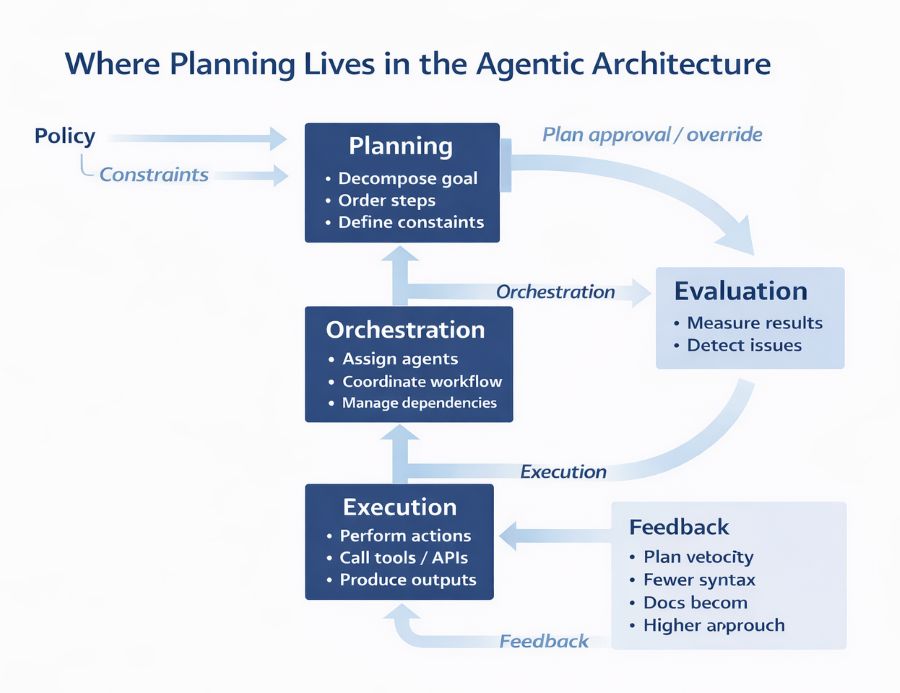
This is why enterprise systems pair planning with orchestration to manage execution flow and escalation paths, tool governance to ensure planned actions stay within boundaries, evaluation to verify progress and validate outcomes, memory to preserve context across execution phases, and human oversight for decisions that exceed agent authority.
Planning defines intent. The surrounding patterns ensure intent becomes reliable outcome.
When Planning Is Strategic (And When It’s Overhead)
Planning works best when tasks have clear structure that can be understood before execution, dependencies between steps matter enough that wrong ordering creates problems, execution must be predictable for compliance or user experience, and coordination across systems or teams requires advance communication.
Planning is less effective, and may introduce unnecessary overhead, when the problem space is poorly understood and discovery dominates, speed to initial action matters more than comprehensive structure, the cost of mistakes is low enough that trial and error is economically rational, or the work is simple enough that planning overhead exceeds execution time.
Understanding this boundary helps enterprises apply planning where it delivers measurable value rather than treating it as a universal requirement.
What QAT Global Has Learned About Planning
At QAT Global, we treat planning as a delivery discipline, not a convenience that happens to be available in the latest AI framework.
Effective planning in AI systems requires clear definitions of success that agents can validate against, explicit assumptions that can be checked before and during execution, built-in checkpoints where progress is verified before continuing, human accountability for high-impact decisions regardless of plan quality, and integration with enterprise delivery practices rather than bypassing them.
Too often, organizations deploy agents with sophisticated planning capabilities that still fail in production because the planning doesn’t align with how the business manages complex work, makes decisions under uncertainty, or handles exceptions.
AI planning should augment and integrate with organizational delivery discipline, not replace it with algorithmic overconfidence.
What Comes Next
Planning brings structure to individual agents working on complex tasks. The next challenge enterprises face is scaling that structure across multiple agents working together on shared objectives.
In the next article in this series, we explore the Multi-Agent Pattern: how specialized agents collaborate to accomplish what individual agents cannot, why coordination becomes the real problem at scale, and what enterprises must do to prevent distributed intelligence from turning into distributed chaos where nobody owns outcomes.
Understanding multi-agent systems is essential for organizations building AI that operates across teams, domains, and workflows.
Planning separates AI experiments from enterprise systems. QAT Global combines strategic pattern selection with AI-augmented software development to build systems that execute complex workflows predictably within enterprise constraints. We help you determine which patterns deliver ROI in your specific context, then engineer solutions that prove it. Start Your AI Strategy Session