How Specialized AI Agents Work Together (And Why Coordination Becomes the Enterprise Challenge)
Even the best running back goes nowhere if the line doesn’t block in sync. Missed blocks or blocks in the wrong direction can cause the entire play to collapse. A team’s success isn’t about individual talent. It’s about coordination, with every player working together toward the same objective. The same is true for multi-agent AI. Specialized agents only create value when they operate as a coordinated system, just like the running back and his blockers. It doesn’t matter how strong the running back is if no one is blocking.
Multi-agent systems take complex work and distribute it across multiple specialized AI agents, each responsible for a specific role while contributing to a shared outcome.
As organizations move from a single agent to multiple specialized agents, complexity grows quickly. Adding another agent introduces new layers of coordination. Communication needs to be structured, roles must be clearly defined, and conflicts have to be resolved. When issues arise, they are often caused by how agents interact with each other rather than by any one agent working incorrectly.
Multi-agent systems represent the first time AI can mirror how real enterprise teams operate, distributing work across specialized roles while maintaining shared objectives. When designed correctly, they unlock levels of scale, parallel execution, and quality that single-agent systems cannot achieve.
The benefits are real. Multi-agent systems divide complex work across specialized roles within the software development lifecycle. One agent gathers and refines requirements, another defines architecture, another generates code, and another tests and validates quality, while others coordinate tasks and track progress. Each agent focuses on a specific function, contributing to a shared outcome. When structured well, this approach mirrors a high-performing development team, where work happens in parallel, quality is continuously evaluated, and everything stays aligned to the overall objective.
Gartner predicts that more than 40% of agentic AI projects will be canceled by the end of 2027 because of rising costs, unclear business value, or poor risk controls. Many of these failures will be multi-agent systems that seemed impressive in demos but could not handle real-world complexity.
The pattern itself is not the issue. The real problem is that many organizations assume multi-agent coordination will sort itself out. It doesn’t, especially not at scale, in production, or when the stakes are high.
What Actually Are Multi-Agent Systems?
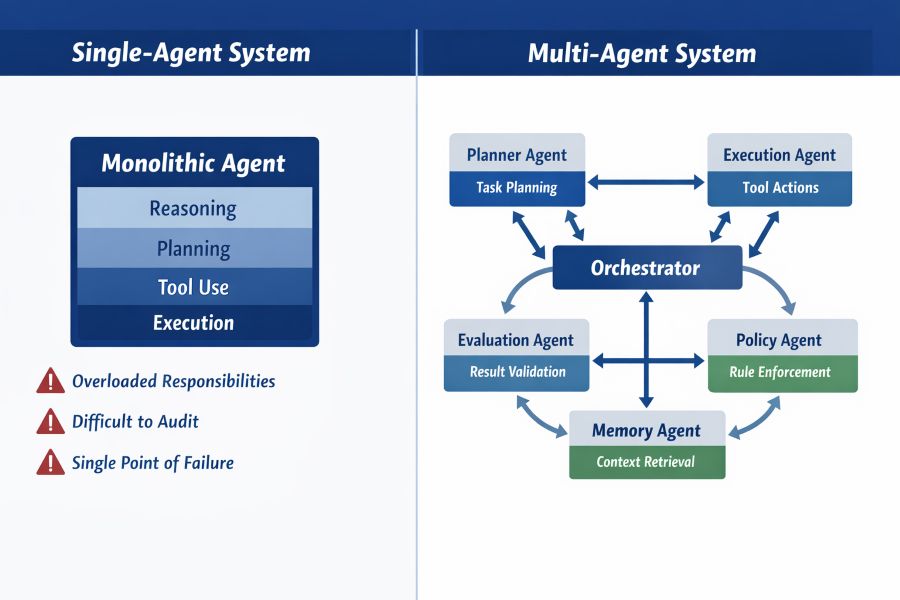
Instead of asking one agent to balance everything (be creative and critical, fast and cautious, exploratory and disciplined), the multi-agent pattern divides the work across specialized agents. Each of these agents focuses on what it does best, and together they work toward a shared objective.
This specialization delivers real advantages. McKinsey’s November 2025 State of AI survey found that 23% of organizations are already scaling agentic AI systems in at least one business function, with another 39% experimenting with AI agents. That’s 62% of enterprises either using or exploring agents, and multi-agent architectures are where many see the most potential.
The use cases are compelling. In complex knowledge work, agents collaborate to research, synthesize, validate, and present findings across massive information spaces. In software engineering, agents specialize in requirements analysis, architecture, coding, testing, and documentation. Each brings focused expertise to their part of the development lifecycle. In business operations, agents coordinate intake, validation, exception handling, and reporting across departments, handling the kind of cross-functional work that traditionally required multiple people and endless handoffs.
However, being capable and being ready for deployment are not the same. This is often where enterprises run into problems.
The Coordination Problem Nobody Discusses in Demos
Multi-agent demos often look impressive because they highlight what’s possible when everything works perfectly. What they don’t show is what happens when you try to scale beyond these ideal conditions.
As you add more agents, coordination gets much more difficult. Communication can become confusing. What one agent calls a “recommendation” might be seen as a “requirement” or even a “mandate” by others. Roles get mixed up, and sometimes two agents both think they’re in charge, so no one actually is. When things go wrong, it’s tough to find the cause because problems come from how agents interact, not just from one agent’s error.
Organizations often learn these lessons the hard way. When agents have unclear roles, they can produce duplicate or conflicting results. If communication breaks down, errors can pile up as agents misunderstand each other. When no one is clearly responsible, it’s hard to know who is accountable. Sometimes, agents get stuck in endless discussions without ever making a decision.
The debugging problem alone kills many multi-agent projects. Forrester research examining real-world performance found that single-term tasks failed 62% of the time, and multi-term tasks did even worse. When you’re trying to trace why a multi-agent system made a wrong decision, you’re not debugging code. You’re piecing together conversations between agents, each with its own reasoning process, trying to figure out where the collective logic failed.
These aren’t just theories. Enterprises face these real failure modes when they put multi-agent systems into production with real consequences.
The Solution: How Production Systems Actually Work
Leaders need to understand that multi-agent systems only succeed when coordination infrastructure is built first.
Just like a football team relies on a defined play, clear roles, and a coach directing execution, multi-agent systems require structure to perform effectively. Without it, players may be talented, but the play breaks down.
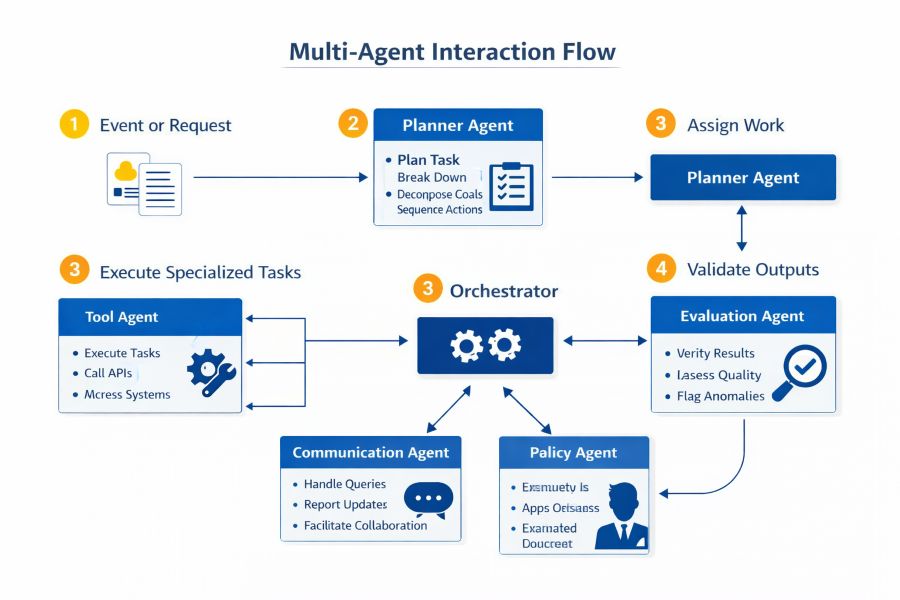
When multi-agent systems succeed in production, they are not agents operating freely or improvising. They are structured systems with clear governance. In practice, this means they operate less like open-ended conversations and more like coordinated workflows, where roles are defined, actions are sequenced, and outcomes are aligned to a shared objective.
Successful deployments pair multi-agent collaboration with orchestration that assigns work and resolves conflicts. They use planning to define roles and dependencies before agents start working, evaluation that enforces quality standards across all agent outputs, human-in-the-loop controls for decisions that exceed defined thresholds, and memory that preserves shared context so agents don’t operate in isolation.
As discussed in the Planning Pattern, having structure before execution decides whether AI systems work predictably or become chaotic. In multi-agent systems, this planning is even more important because you are coordinating several reasoning processes, not just one.
McKinsey highlights that multi-agent orchestration frameworks like LangGraph and AutoGen enable specialized agents to delegate, monitor, and reconcile their work. These frameworks exist precisely because unstructured agent collaboration fails at scale.
Forrester’s 2026 predictions emphasize that vendors adopting open standards, such as the Model Context Protocol for AI agent collaboration, will have a higher probability of early, enterprise-wide adoption of cross-platform agentic workflows. Interoperability matters when you’re managing fleets of agents across departments, each potentially built on different platforms but needing to work together.
The lesson is clear: multi-agent collaboration only works when it’s structured with clear rules. If organizations skip this step, they often realize too late (after the system is live) that adding governance later is much harder.
Why This Is the Breaking Point for Enterprise AI
Up until this point in the agentic patterns series, most challenges could be managed through careful prompt design and tooling. Multi-agent systems break that model entirely.
Once agents need to collaborate:
- Someone must decide who acts when there’s ambiguity.
- Someone must resolve conflicts when agents disagree.
- Someone must stop the system when it’s heading down an unproductive path.
- Someone must be accountable when something goes wrong.
McKinsey’s September 2025 research on agentic organizations warns that the proliferation of AI agents without the proper context, steering, and orientation can be a recipe for chaos. This isn’t hyperbole. It’s what happens when you deploy agents without orchestration.
Multi-agent systems without orchestration are like organizations without leaders. They create activity without direction, conversations without decisions, and movement without real progress.
Gartner predicts that 70% of AI applications will use multi-agent systems by 2028. The technology is advancing quickly, but most companies’ governance can’t keep up. This gap between what’s possible and what’s manageable is why so many projects get canceled.
How to Make Multi-Agent Systems Work in the Enterprise
Multi-agent systems do not succeed by simply adding more agents. They succeed because of strong structure.
At QAT Global, we apply three principles:
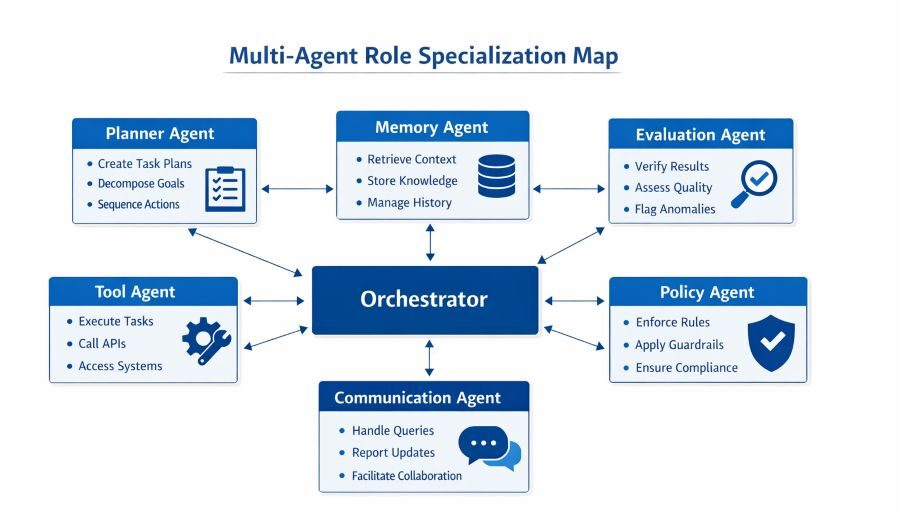
Define clear roles and boundaries. Each agent is responsible for a specific function with clear inputs and outputs, so there is no confusion about responsibilities. Unlike the Tool Use Pattern where a single agent manages its own tool access, multi-agent systems spread tool use across specialized roles with centralized oversight.
Control orchestration from a central point. Workflows are managed through set sequences, not by letting behavior emerge on its own. There is always someone in charge.
Keep humans in the loop where judgment matters. AI executes. Humans validate, approve, and guide decisions that carry risk or require business context.
Applying these three principles transforms multi-agent systems from experimental architectures into governed delivery systems that operate predictably in production.
What Production Multi-Agent Systems Actually Look Like
When multi-agent systems work in production, they’re never just agents chatting with each other freely. They’re structured systems with explicit governance.
Successful deployments pair multi-agent collaboration with:
- Orchestration that assigns work and resolves conflicts.
- Planning that defines roles and dependencies before agents start working.
- Evaluation that enforces quality standards across all agent outputs.
- Human-in-the-loop controls decisions that exceed defined thresholds.
- Memory that preserves shared context, so agents don’t operate in isolation.
McKinsey highlights that multi-agent orchestration frameworks like LangGraph and AutoGen enable specialized agents to delegate, monitor, and reconcile their work. These frameworks exist precisely because unstructured agent collaboration fails at scale.
The lesson is clear: multi-agent collaboration only works when it’s structured with clear rules. If organizations skip this step, they often realize too late (after the system is live) that adding governance later is much harder.
QAT Global’s Perspective: Teams Need Leadership
Multi-agent systems require more than intelligent agents. They require structure.
At QAT Global, we help organizations move beyond experimentation by integrating multi-agent systems into established delivery workflows. Instead of relying on agents to self-organize, we apply proven principles from software development to ensure coordination is intentional, governed, and scalable.
Effective multi-agent systems are built on:
- Clear role definitions and boundaries
- Defined decision authority
- Governance through quality gates and controls
- Human accountability for outcomes
- Delivery discipline across staging, testing, and release
Without this foundation, systems generate activity but not progress. Agents may perform individually, but the overall system fails to deliver consistent results.
Organizations that succeed treat multi-agent systems like teams. They design for coordination from the start, not as a fix later. That shift—from experimentation to operational discipline—is what separates pilots from production.
If you’re looking at multi-agent systems, the real question is not if your agents can coordinate, but if your organization has built the foundation that makes coordination governable. We help enterprises answer that question honestly before they invest too much. Learn more at qat.com/artificial-intelligence-ai.
Final Takeaway
The multi-agent pattern is powerful when applied to the right problems. It enables parallel execution, specialization, and higher-quality outcomes across complex workflows.
But more agents do not guarantee better results. Without coordination, they increase complexity without adding value.
Success comes down to structure: clear roles, defined workflows, and governed execution.
What Comes Next
Multi-agent systems introduce a new requirement: oversight.
As agents begin to collaborate, make decisions, and act across systems, coordination must be actively managed. This is where orchestration becomes essential.
In the next article, we explore the Orchestration (Supervisor) Pattern—the layer that assigns work, resolves conflicts, and ensures accountability across agents.
QAT Global turns multi-agent AI theory into real enterprise solutions. when specialized agents add value or increase risk, design coordination systems that stay manageable at scale, and deliver custom solutions that work reliably in production. Our AI- Accelerated Software Development speeds up delivery while keeping the governance and quality that enterprises require. Contact us to discuss whether multi-agent patterns are right for your environment. Start Your AI Strategy Session.
Explore more agentic workflow patterns at qat.com/essential-agentic-workflow-patterns-enterprises, or read about other foundational patterns such as Reflection, Tool Use, ReAct, and Planning.
- How Specialized AI Agents Work Together (And Why Coordination Becomes the Enterprise Challenge)
- What Actually Are Multi-Agent Systems?
- The Coordination Problem Nobody Discusses in Demos
- The Solution: How Production Systems Actually Work
- Why This Is the Breaking Point for Enterprise AI
- How to Make Multi-Agent Systems Work in the Enterprise
- What Production Multi-Agent Systems Actually Look Like
- QAT Global’s Perspective: Teams Need Leadership
- Final Takeaway