The Problem: AI Is No Longer an Isolated Experiment
Over the past few years, many organizations have successfully demonstrated value with AI through POCs, internal chatbots, or isolated automation initiatives. However, when AI becomes a structural part of a product or the core of the business, clear limitations begin to surface:
- Models configured without proper governance
- Fragile and poorly auditable data pipelines
- Excessive coupling between applications and models
- Lack of control over cost, latency, and versioning
- Difficulty meeting enterprise security requirements
Isolated tools, like a model endpoint here or an embedding script there, do not scale at an organizational level. The challenge is no longer how to call an LLM, but how to operate AI as a platform with the same rigor applied to data, identity, and mission-critical applications.
It is within this context that Microsoft Foundry emerges, not as another isolated service, but as a unifying layer for designing, governing, and operating AI solutions on Azure.
Why This Is Hard in Practice
Designing enterprise AI systems is difficult, not because of inference itself, but because of the non-functional requirements that surround it.
Recurring challenges in enterprise environments include:
Security and identity
Models must comply with the same security perimeter as corporate APIs. Authentication, authorization, and environment segregation are mandatory.
Governance and compliance
It must be possible to determine which model, which version, and which data produced a given response.
Integration with proprietary data
AI without access to internal data quickly loses value. Exposing corporate data to models, however, requires strict controls.
Cost and predictability
Calls to language models are inherently variable and, without observability, quickly become financially unpredictable.
Organizational maturity
Data, product, and platform teams often operate in disconnected silos.
Foundry does not “solve AI.” Instead, it addresses these issues as a platform architecture problem, not as an SDK.
What Is Microsoft Foundry (Conceptually)
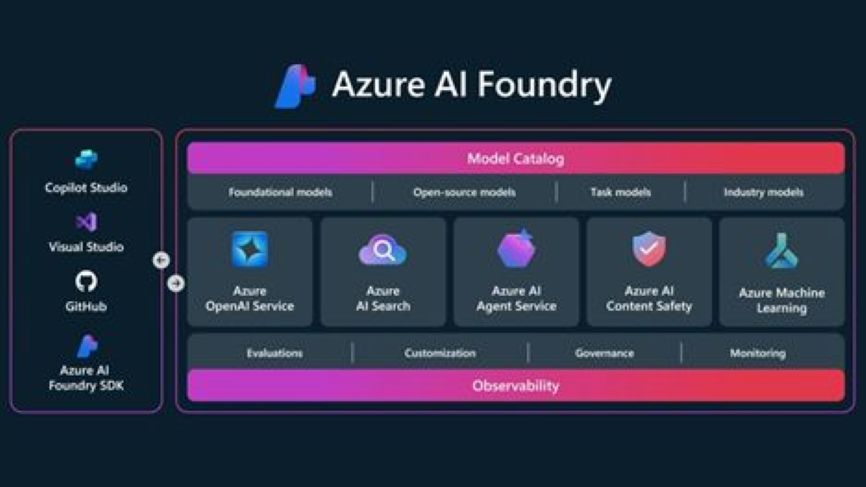
Microsoft Foundry is an integrated environment for building, orchestrating, and operating AI solutions, combining:
- Models (foundational and customized)
- Data (structured and unstructured)
- Evaluation and observability tools
- Security and governance controls
- Native integration with applications
It acts as a control plane for AI, abstracting operational complexity without hiding critical architectural decisions.
Rather than thinking in terms of “using a model,” Foundry encourages thinking in terms of composed AI systems, built from multiple well-defined components.
Reference Architecture with Microsoft Foundry
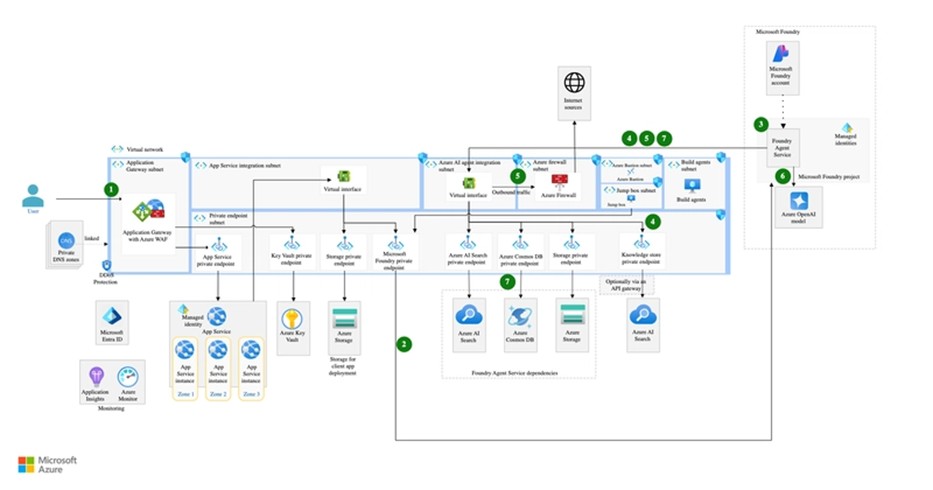
In a typical enterprise architecture, Foundry positions itself as a central orchestrator, integrating services already familiar within the Azure ecosystem.
Key components include:
Models and inference
Azure OpenAI Service for language models and embeddings, with model versioning and deployment control.
Data and RAG (Retrieval-Augmented Generation)
Azure AI Search as the semantic indexing engine, with a clear separation between source data and the context provided to the model.
Applications
APIs built on Azure Functions or Azure App Services, integrated with existing .NET applications.
Security and identity
Authentication via Microsoft Entra ID, consistent RBAC across data, models, and applications, and support for private endpoints and network isolation.
The core principle is clear: the model is never accessed directly by the end user. Access is always mediated by an application layer and enforced policies.
Architectural Decisions and Trade-offs
What Foundry enables:
- Standardization of model consumption patterns
- Reproducibility and traceability
- Native integration with the Azure ecosystem
- Incremental evolution without rewriting applications
What it does not eliminate:
- RAG design decisions remain critical
- Data quality remains the team’s responsibility
- Costs still require active monitoring
A common alternative, and why it fails:
A frequent approach is to connect applications directly to model endpoints, managing context and prompts within application code.
This may work in the short term, but fails when multiple teams create inconsistent patterns, there is no centralized version control, and auditing and troubleshooting become impractical.
Foundry trades some initial flexibility for organizational consistency and long-term scalability.
Real-World Implementation Considerations
Deployment and versioning
Models should be treated as versioned artifacts, with explicit separation between development, test, and production environments.
Observability
Latency, token consumption, and error rates must be measured and correlated with business-level requests.
Costs
Limits and alerts should be implemented from the start, and caching strategies for responses and embeddings should be evaluated.
Security
Model endpoints should never be publicly exposed, and managed identities should be used whenever possible.
Common Mistakes and Anti-Patterns
- Treating Foundry as “just another portal”
- Centralizing all business logic inside prompts
- Ignoring governance in favor of speed
- Assuming the model will “fix” poor-quality data
These are not merely technical mistakes; they are failures of architecture and technical leadership.
Strategic Takeaways for Technical Leadership
For CTOs and architects, Microsoft Foundry represents an important shift in mindset:
- AI must be treated as a platform, not a feature
- Governance is not optional; it is an enabler
- Architecture must survive changes in models
- Competitive advantage lies in integration with data and processes
Organizations that adopt Foundry correctly are not simply “using AI.” They are building institutional capability to operate AI at scale, with security and predictability.
Disclaimer
This article is authored by me, Ray Carneiro, and was grammatically reviewed with the support of AI tools. The technical and conceptual information presented is public and can be found in Microsoft’s official documentation. The value of this material lies in its critical analysis and strategic construction, focusing on architectural decisions and practical challenges faced by organizations in enterprise environments.